Extractors have long employed a discharge sequence that slowed the machine, executed a rib inflation, deflation and jog sequence (if so equipped), and then tilted up to discharge. Some machines without inflatable ribs would obviously just stop and the tilt to discharge. The discharge is triggered by a speed sensing circuit that begins the sequence at slow speed.
For goods that do not cling or plaster to the cylinder (like poly napkins and table linen) we enabled what we called the "fast discharge" option. This uses a different speed sensing circuit (that triggers at higher speed) and allows the discharge sequence to begin while the extractor is still decelerating from extract speeds.
If configured for the Fast Discharge option, you can select the discharge type in the extract code programming page. You can thus select some goods to fast discharge while others would use a standard sequence and possibly rib inflation (if so equipped).
The discharge sequence is customizable in extract code programming to accommodate differing goods.
Both discharge types use a speed sensing board to trigger the next action. A photo eye on the rear pulley inputs to 2 separate speed sensing boards, with differing speed triggers. If the photo eye at the rear pulley is malfunctioning, both boards will show "slow", and the discharging event sequence will trigger more quickly than it should.
The standard board, 08BNDSR1T, does not have a LED. The relay pulls in when speed is above slow. The relay makes an input on the I/O board 1MTA4-11.
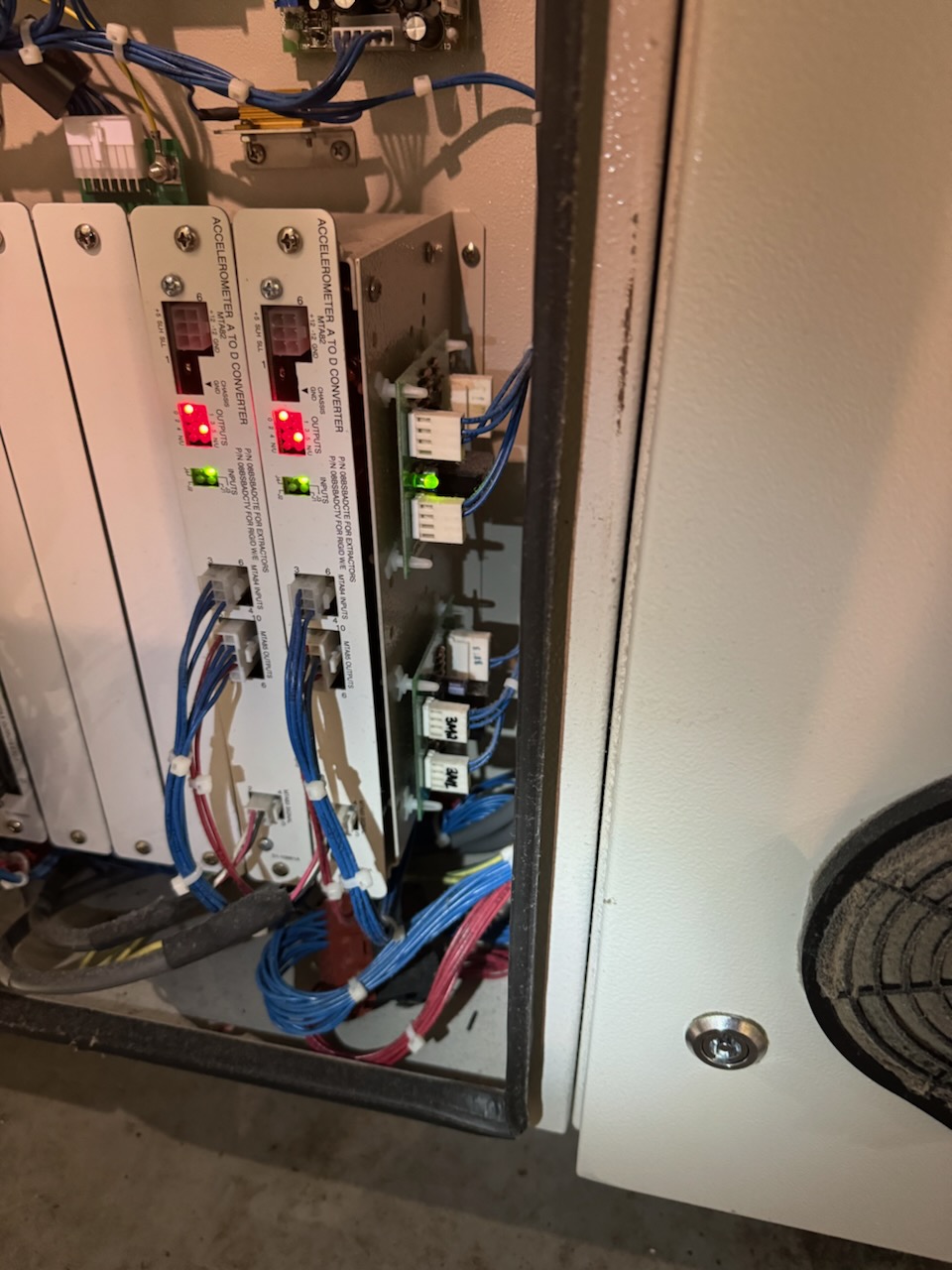
The fast discharge sensing board, 08BNDSRDT, does have a LED on it. The LED is on if speed is slow. The relay is off at slow speed. The trigger speed is higher for the fast discharge board than the standard board. The relay makes an input on the I/O board 4MTA4-2.
The speed sensing boards are mounted on the right side of the card cage. The fast discharge board is on the top.