General Idea
The dryers produce lint, lots of lint. Cleaning a lint filter every cycle would be time consuming and tedious. A lint collector automates the process and reduces the amount of time personnel take to remove lint from the system.
Internal Lint Screens
This option adds internal lint screens, air nozzles, and pneumatic gate valve to a dryer. Lint accumulates on a filter screen. At the end of the cycle, the screen is stripped with an air wand. At the same time, the gate valve opens and the collection system pulls lint from the Milnor dryer. After blow down, the gate valve stays open for 12 seconds to allow the lint time to travel from the dyer to the lint collector, DryVac.
Centralized Lint Collection
There are many companies that make a centralized collection unit. This provide a "hands-off" approach for the dryers. The dryers do not need to send cleaning signals to the lint system, it will typically be set to clean by time.
Individual Lint Collection (Energenics MLF)
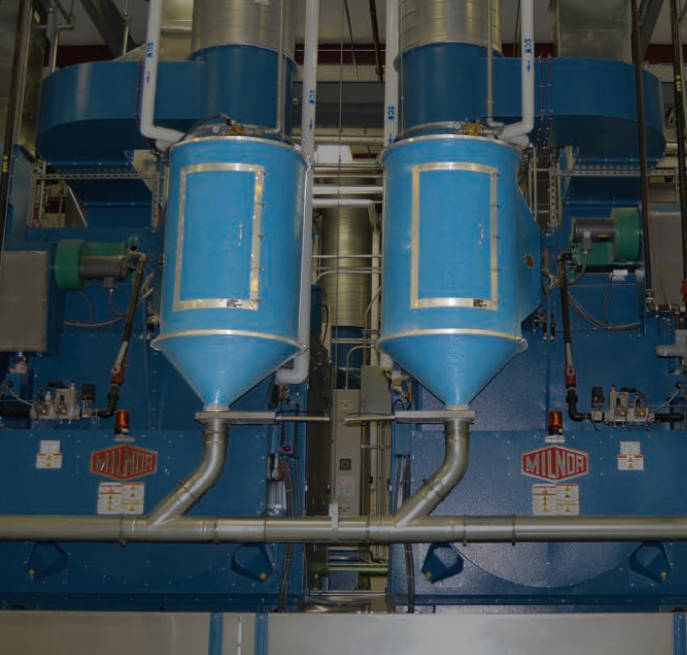
This includes Milnor MLFs by Energenics, and other systems. Lint accumulates on a filter screen. At the end of the cycle, the screen is stripped with an air wand. The free lint then falls into a collection sock. When the sock is full, open the bottom and empty.
Parts for Energenics components can be found at Milnor Lint Filter Archives | Energenics
The MLF by Energenics has three components tied into the Milnor dryer.
- 120V Solenoid for Air
- 120V Solenoid for Water
- Fire Detection Probe
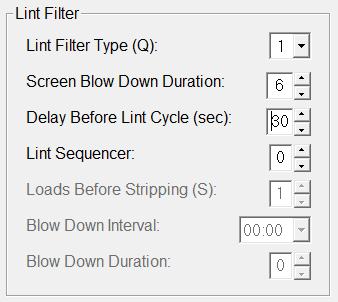
This is typically set in the following configuration.
NOTE: The Delay Before Lint Cycle is set based on whether or not you have an inverter driven blower.
Inverter Blower: 0 Sec
Non-Inverter Blower: 30-40 Sec