Milnor machines can extract up to 1000RPM! If that were to coast to a stop, it would take a while, but we need to get linen out quickly and this waiting time eats into your production goals. Milnor uses inverter dynamic braking and mechanical braking systems (like the brakes on a car) on our machines. These may be utilized together or separately depending on your machine.
Inverter Based Braking (Dynamic Braking)
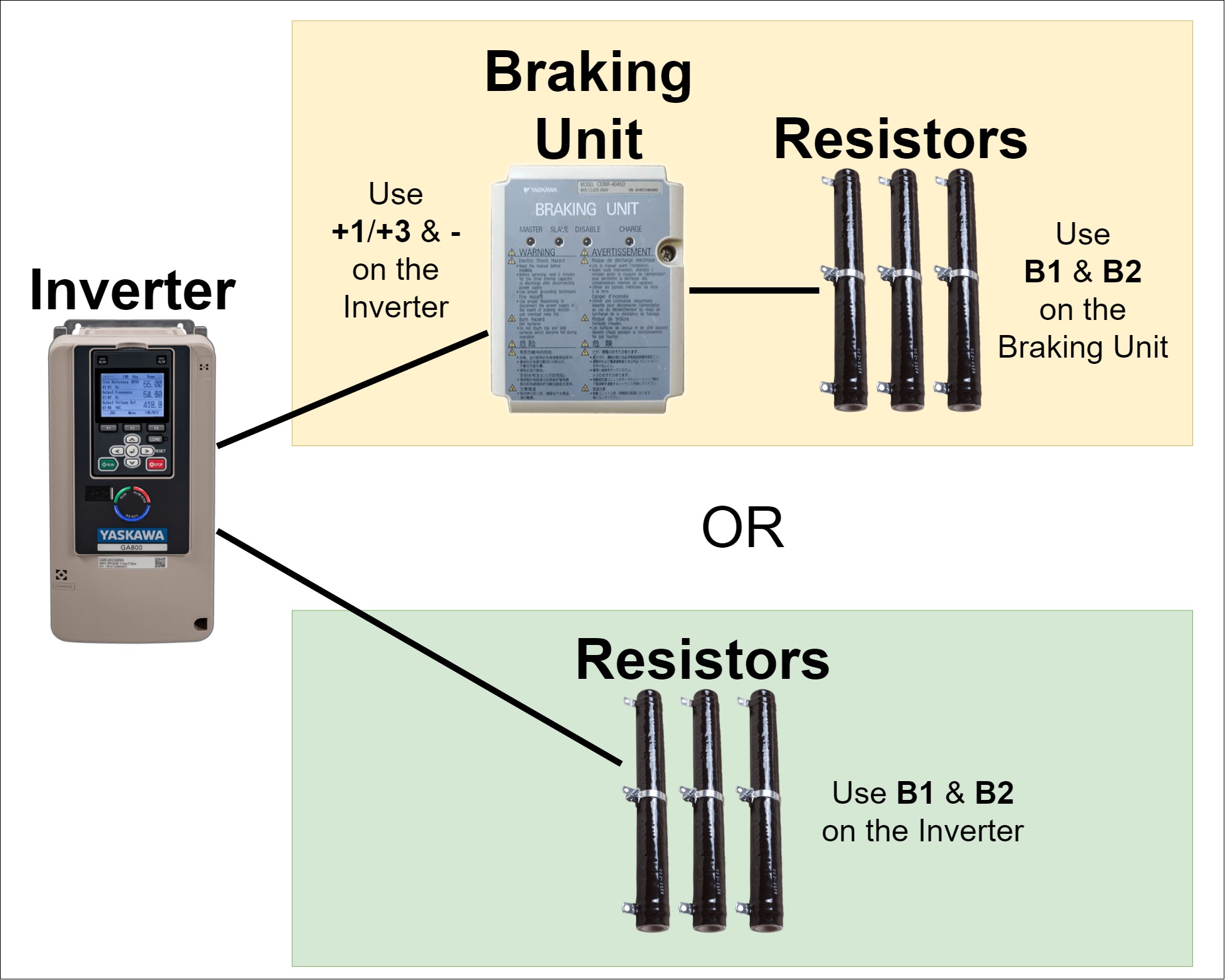
To slow a machine the inverter changes the frequency output and the motor slows down. But this causes some backfeed of power to the inverter from the motor. This generates excess DC voltage and needs to be dissipated. The excess voltage dissipates through braking resistors and convert the excess voltage to heat. If the inverter does not have the capacity to pass enough excess energy to the braking resistors, a braking unit is added to the system to handle the excessive load pass to the braking resistors as previously mentioned. The diagram below shows an inverter being wired for either configuration.
Mechanical Based Braking
Before inverters came about, we slowed machines down utilizing mechanical brakes. Some larger machines still use mechanical brakes in addition to the having an inverter braking system. Brakes can take various forms. There are band brakes, disc brakes, and drum brakes. Note, these work independently of the inverter based braking even if they are both slowing the rotation of the machine.
Some mid-size and larger washer extractors use a mechanical brake and a small rotor normally mounted to the motor. These brake systems are somewhat small and are not made to stop rotation from speed but made to clamp a stopped cylinder and prevent it from rotation when an operator is unloading the machine.


